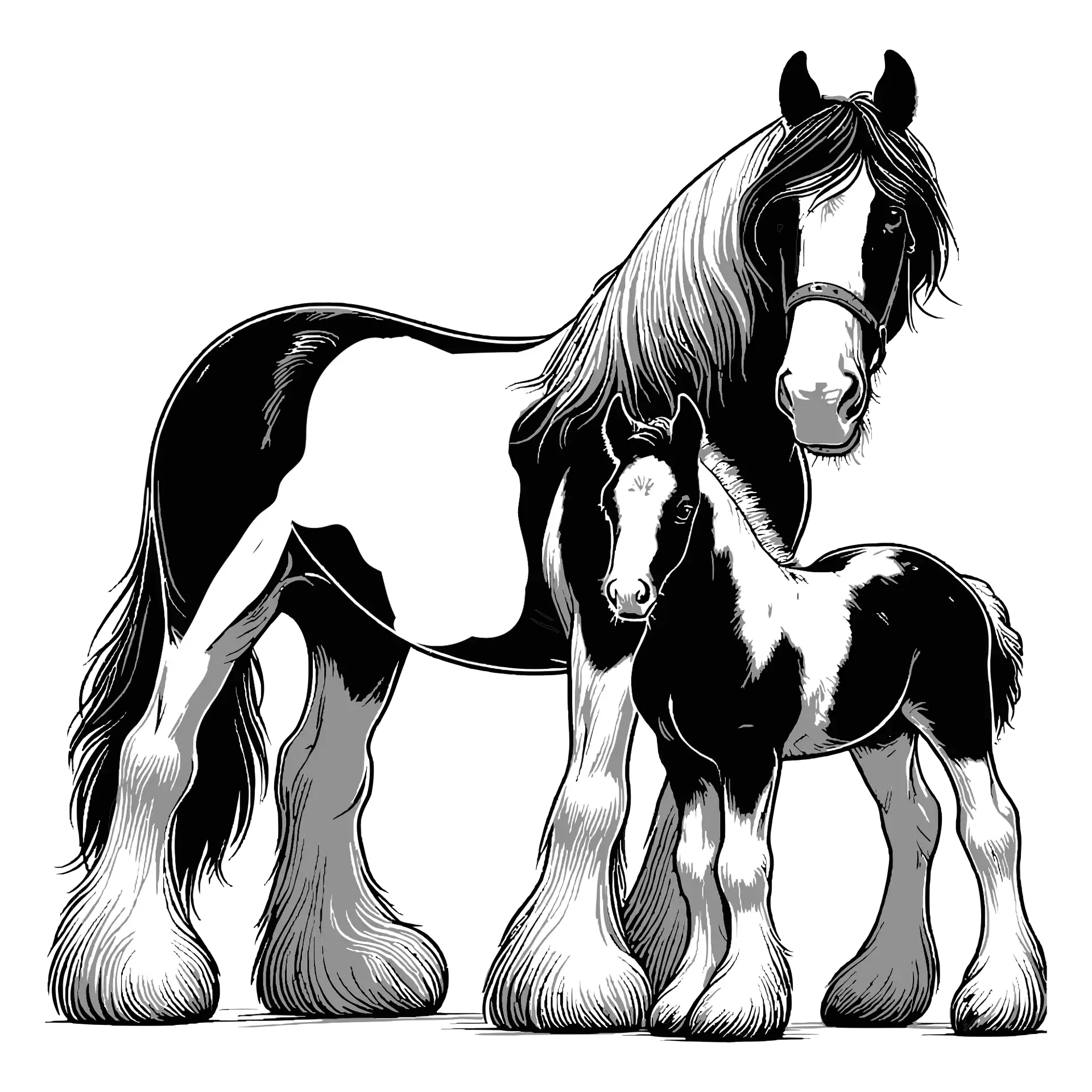
The Traditional Cob
The Traditional Cob
Authored By
The Traditional Cob Registry
The Traditional Cob
Geographical origins
The Traditional Cobs of Ireland and Great Britain (England, Scotland and Wales) are the Irish Cob from Ireland and the Gypsy Cob from Great Britain (England, Scotland and Wales).

Geographical and political clarification
The United Kingdom (UK) is a sovereign state (blue on map) with a monarchy comprising Great Britain (England, Scotland and Wales) and Northern Ireland.
Ireland (aka the Republic of Ireland) is a separate sovereign (green on map) with no monarchy. Ireland gained independence from the United Kingdom on 6 December 1921, when representatives of the two states signed the Anglo-Irish Treaty.
Because the British Isles include the island of Ireland (Ireland and Northern Ireland) and the island of Great Britain (England, Scotland and Wales), some mistakenly think that Ireland is part of Great Britain.
NOTE: Although the United Kingdom (UK) left the European Union (EU) in 2020, Ireland remained in the European Union (EU).
The Irish Cob
The original Traditional Cob
The original Traditional Cob—the first Traditional Cob breed type—is the Irish Cob, which was bred in Ireland by Irish Travellers (historically referred to as Tinkers).
A short history of Irish Travellers
Some of the world-renowned original Traditional Cob (Irish Cob) stallions born in Ireland are: The Lion King, The Road Sweeper, The Paddy Horse, The Coal Horse, Bob The Blagdon, The Sham, Shampoo Boy, The Lob-Eared Horse (aka The Lob), Old Henry, Eddie Alcocks Old Black Horse of Ireland, The Checkity Horse, The Old Horse Of Ireland, The Old Paddy Horse, The Kerry Horse, Shambo and Sonny Mays.
The Irish Cob Studbook (Ireland)
On 18 July 1996, the Irish Cob Studbook was officially recognised in Ireland.
On 16 July 1998, The Irish Cob Society (ICS)—the Society (Organisation) established by Evelyn Flynn (formerly Evelyn Murphy)—was officially recognised in Ireland and by the Commission of the European Union (EU) as the body (breed society) which was approved to maintain the Irish Cob Studbook as the EU studbook of the origin of the breed (the EU ‘Mother’ Irish Cob Studbook).
NOTE: The Irish Cob Breed Standard—which was authored by Evelyn Flynn (formerly Evelyn Murphy) for the ‘Mother’ Irish Cob Studbook that was established and maintained by ICS—is the original Traditional Cob breed standard.


The original 1990's Irish Cob
It is the athletic and versatile, up to 16.2hh, all-purpose (ride and drive) original Traditional Cob from Ireland (Irish Cob), that from the 1990s made the Traditional Cob so popular as a leisure horse, not just in Ireland and Great Britain (England, Scotland and Wales) but also in countries such as Germany, Netherlands, France, Belgium, Sweden, Denmark, Finland, Czech Republic, Spain, Italy and also in the USA and Australia, etc.
In addition to being ridden and shown worldwide in its full 'traditional splendour' of abundant leg feathering and long, thick flowing mane and tail, clipped out and hogged, the Irish Cob remains a common sight on the hunting fields of Ireland and Great Britain (England, Scotland and Wales), as well as in cob showing classes in Ireland and Great Britain (England, Scotland and Wales).
Daughter Irish Cob Studbooks
Since The Irish Cob Society (ICS) officially established the ‘Mother’ Irish Cob Studbook in Ireland in 1998, ICS trained and approved breed societies in other EU Member States to establish their own Irish Cob Studbooks, which the other breed societies were subsequently officially recognised by their own EU Member States and by the Commission of the European Union (EU) to maintain as ‘Daughter’ Irish Cob Studbooks subject to the Principles laid down by the Irish Cob Society (ICS) in Ireland (the organisation or association which maintained the studbook of origin of the breed).
The Gypsy Cob
Although from the 1990s, Ireland's original Traditional Cob (Irish Cob) has also been referred to as the Gypsy Cob, the true Gypsy Cob—the second Traditional Cob breed type—was developed in Great Britain (England, Scotland and Wales) by Romany people (historically referred to as Gypsies).
Romani people in Great Britain (England, Scotland and Wales) developed the Gypsy Cob by selectively breeding the Irish Cob, to maximise the stockiness and heavy bone and feather of the Irish Cob, to reduce the height of the Irish Cob, and to add driving cob characteristics attributed to the Welsh Cob—including a more driving cob type shoulder, withers and chest and a sweeter ‘Welsh type’ head. Although the Gypsy Cob is typically 13.1hh to 15.2hh, a Gypsy Cob that is from 14.2hh to 15.2hh can be more akin to the Irish Cob insofar as it can have a more athletic structure and longer legs than the smaller 13hh to 14.2hh Gypsy Cob.
Some of the world-renowned Gypsy Cob stallions born in Great Britain (England, Scotland and Wales) are: Vines Lloyds, Hercules, Bullseye, SD Big News, Top Gun, Warrior, SD Wooly Mammoth, SD The Rocking Horse, and SD Street Fighter.
NOTE: The Mini Gypsy Cob (aka Mini Cob) was developed in Great Britain (England, Scotland and Wales) by Romani people (historically referred to as Gypsies), by selectively breeding the Gypsy Cob to reduce its height.
The Traditional Gypsy Cob Studbook (UK)
In 2012, the Traditional Gypsy Cob Association (TGCA)—which is in England—was officially recognised in the United Kingdom (England, Scotland, Wales and Northern Ireland) and by the Commission of the European Union (EU) as the breed society that was approved to maintain the Traditional Gypsy Cob Studbook as the EU studbook of the origin of the breed (the EU ‘Mother’ Traditional Gypsy Cob Studbook). However, from the time the United Kingdom (England, Scotland, Wales and Northern Ireland) left the European Union (EU) in 2020, the Traditional Gypsy Cob Studbook has only been officially recognised in the United Kingdom (England, Scotland, Wales, and Northern Ireland) as the UK studbook of the origin of the breed (the UK ‘Mother’ Traditional Gypsy Cob Studbook).
NOTE: Because the Gypsy Cob (aka the Traditional Gypsy Cob) was developed in Great Britain (England, Scotland and Wales) by Romany people (historically referred to as Gypsies) as the second Traditional Cob breed type, the Traditional Gypsy Cob Breed Standard is therefore different from the Irish Cob Breed Standard—the original Traditional Cob breed standard. It is for this reason that the Traditional Gypsy Cob Studbook could be officially recognised as an EU or UK studbook of the origin of the breed (EU or UK 'Mother’ Traditional Gypsy Cob Studbook).
Outside Ireland & Great Britain
It was not until the early 1990s that the Traditional Cob (Irish Cob and Gypsy Cob) became known outside Ireland and Great Britain (England, Scotland and Wales).
The Tinker
From the 1090s, outside Ireland and Great Britain (England, Scotland and Wales), Ireland's original Traditional Cob (Irish Cob) has also been referred to as the Tinker.
The Tinker Studbook (Netherlands)
Although by the mid-1990s, hundreds of unregistered Irish Cobs from Ireland had already been imported into the Netherlands, it is because it was not made known by Ireland to the other EU Member States (in accordance with Article 5 of Council Directive 90/427/EEC) that The Irish Cob Society (ICS) was officially recognised in Ireland in July 1998 and by the Commission of the European Union (EU) as the breed society which was approved to maintain the Irish Cob Studbook as the EU studbook of the origin of the breed (the EU ‘Mother’ Irish Cob Studbook), that in October 1999 the Nederlands Stamboek voor Tinkers (NSvT) was officially recognised in the Netherlands and by the Commission of the European Union (EU) as the breed society that was approved to maintain the Nederlands Stamboek voor Tinkers (NSvT) as the EU studbook of the origin of the breed (the EU ‘Mother’ Tinker Studbook).
The Tinker in Germany
Although by the mid-1990s, hundreds of unregistered Irish Cobs from Ireland had already been imported into Germany, it is because it was not made known by Ireland to the other EU Member States (in accordance with Article 5 of Council Directive 90/427/EEC) that The Irish Cob Society (ICS) was officially recognised in Ireland in July 1998 and by the Commission of the European Union (EU) as the breed society which was approved to maintain the Irish Cob Studbook as the EU studbook of the origin of the breed (the EU ‘Mother’ Irish Cob Studbook), that animals of the Irish Cob breed are recognized in Germany as Tinkers by the German Equestrian Federation (FN) as well as Irish Cobs.
NOTE: Although Ireland did not make it known to the other EU Member States (including the Netherlands and Germany) that there was already an EU studbook of the origin of the breed in Ireland—in the actual country of the origin of the breed—for the Irish Cob (the EU ‘Mother’ Irish Cob Studbook), when in the 1990s the Netherlands and Germany gave Ireland's original Traditional Cob (Irish Cob) another Irish name (Tinker), the Netherlands and Germany implicitly recognised not only the fact it was Irish Travellers in Ireland (historically referred to as Tinkers) who created the breed, but also that Ireland is the actual country of the origin of the breed.
The Gypsy Vanner Horse
From at least the 1970s, unregistered Irish Cobs from Ireland were imported into Great Britain (England, Scotland and Wales), where they were used by Romany people (historically referred to as Gypsies) as the foundation breed to develop their true ‘English type’ Gypsy Cob (the second Traditional Cob breed type). From 1996, some of these unregistered Irish Cobs (original ‘Irish type’ Gypsy Cobs) from Ireland were imported into the USA in 1996, where they were given the name the Gypsy Vanner Horse.
The Gypsy Vanner Horse Society (USA)
Although the Gypsy Vanner Horse Society (GVHS) in the USA still claims to have founded the first (original) registry for the breed on 14 November 1996, the Irish Cob Studbook, which was officially recognised in Ireland on 18 July 1996, is the first (original) registry for the breed.
NOTE: Although the original 1990's Gypsy Vanner Horse was the big athletic Irish Cob from Ireland, because of the influence of the true ‘English type’ Gypsy Cob (aka Traditional Gypsy Cob) from Great Britain (England, Scotland and Wales), the Gypsy Vanner Horse has changed since the 1990s to become more true to the Gypsy Cob (aka Traditional Gypsy Cob) breed type.
All Share Irish Roots
Because Ireland is the country of origin of the Traditional Cob, all Traditional Cobs in the world—no matter which Traditional Cob breed type they are (Irish Cob or Gypsy Cob) or no matter what breed name they have (Irish Cob, Tinker, Gypsy Cob, Gypsy Vanner/Gypsy etc.)—are either Traditional Cobs from Ireland or the descendants of Traditional Cobs from Ireland. All Traditional Cobs in the world therefore share the same Irish ancestral roots.
The Traditional Cob Registry
The worldwide registration platform for Irish Cobs and Gypsy Cobs.