
Irish Cob
- Registered
- 415 horses
- Section
- Traditional Cob › Primary
411 horses

Traditional Gypsy Cob

Irish Cob

Irish Cob

Traditional Gypsy Cob

Part Bred Traditional Cob

Traditional Cob x Hanoverian

Irish Cob

Traditional Cob

Gypsy Cob

Irish Cob

Traditional Irish Cob

Part Bred Irish Cob

Irish Cob

Irish Cob

Irish Cob
Written by Evelyn Flynn
The Irish Cob is compact and powerful, ample both in muscle and bone, yet, with an ability to perform as a good all‐purpose animal. Some Irish Cobs tend to be more “stocky” than others. The Irish Cob is well balanced and proportioned, standing straight and square and offering an imposing appearance.
The head, which should be held proudly, should be carried on a powerful and arched, well “set on”, neck. The neck should appear to “carry on” through good withers and to finish at the start of the back (this feature should be particularly evident in stallions). The back, which should be short and straight, should slope gently upwards to a well-muscled croup (the backbone/spine or the hip bones should not be apparent). The croup, which is quite high and generous, the backbone should have both croup muscles well defined, the top of the quarters being exceptionally well muscled, broad and ample. The angle of the spine from the croup to the tail should slope gently downwards and should not be exaggerated; this allows for a high, well “set on”, tail and contributes to good well-rounded quarters.
Irish Cobs are from medium weight to heavy weight, (Some allowance in bone measurement can be made for mares and geldings only).
Irish Cobs with their unique action, luxuriant hair and feathering and the large range of colours available, combine to present a beautiful and varied sight to see when turned out at their best, particularly when in motion.
The Irish Cob should possess a docile and willing nature, with a friendly disposition towards humans and other animal species. Displays of aggressive and threatening behaviour such as ears back, kicking, biting, rearing and not being under control of the handler, will result in expulsion from Approval Inspection and the Show Ring.
Under 170cms (not exceeding 16.2 hands).
Should be straight, handsome and in proportion to the rest of the horse. The forehead should be broad and the muzzle, jaw and cheek should be generous.
Should have a level bite.
Should be quite bold, open and set well apart.
Should be neat and well set on.
Should be compact, but not too short and should be generously muscled, including the crest (stallion’s necks should be particularly well muscled and crested).
Should be ample, powerful and sloping.
Should be of average protrusion or height and should be encased in plenty of muscle and flesh.
Should be powerful, well-muscled and not too broad or narrow.
Should be short, straight, well covered in muscle and flesh and slope gently upwards towards the croup.
Should be very generous, well-rounded, broad and powerful with a well-muscled high croup. The second thigh should also be very generous, quite long and well coupled to good straight powerful hocks. The hind legs should be well boned and muscled.
Should be short and compact with ribs well sprung to barrel shape.
Should be powerful and not too short. There should be a good length of well-muscled forearm and generously boned shins.
Should be well developed and of generous dimensions but should be in balance with the proportions of the horse.
Should match the other joints in power, size and build.
Should also be of sufficient bone and not too long (straight or over-angled pasterns are a fault).
Should be well-shaped, neat and of a size capable of carrying the frame of the horse without stress.
Leg hair/feathering is a characteristic and decorative feature of the Irish Cob breed. This is especially prominent in the heavier Irish Cobs. However, the amount of leg hair/feathering present may vary considerably, particularly in the case of medium weight Irish Cobs. Leg hair/feathering should, at the very least, fall from the back of the knees and hocks, down to a thick covering of hair/feathers on the heels. Leg hair/feathering should also fall over the front of the hoof, from at least the coronet.
Should be luxuriant and capable of growing to a substantial length.
Should appear sound and free from obvious hereditary defects.
The following colours are considered most typical.
Although described as a ‘draught’ type animal, the Irish Cob breed also remains a dual-purpose animal, by retaining the docile character attributed to the cold-blooded breeds, while retaining the breed’s agile and versatile capabilities, which are ideally suited to a number of leisure riding pursuits.
NOTE An Irish Cob is still an Irish Cob even if it has had its mane and/or leg hair/feathering removed.
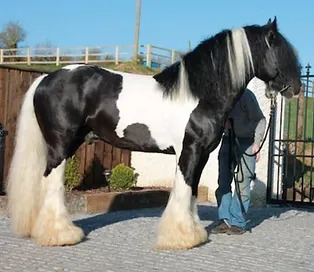
To understand the Irish Cob Breed Standard, it is important to know the history of the breed and, therefore, why the Irish Cob is a riding cob that can be driven.
After World War II, Irish Travellers used cobs bred in Ireland (ROI) by Irish farmers, crossed with the Clydesdale and Shire, to create the original Traditional Cob, which was officially recognised (documented) in Ireland (ROI) on 18th July 1996 as the Irish Cob.
It is because cobs bred in Ireland by Irish farmers had a riding cob structure (the dimensions and proportions attributed to the riding cob, including a good riding cob shoulder and chest) that the cobs bred in Ireland by Irish farmers were riding cobs that could be driven. It is therefore the influence of the cobs bred in Ireland by Irish farmers that gave the original Traditional Cob (Irish Cob) a riding cob structure (the dimensions and proportions attributed to the riding cob, including a good riding cob shoulder and chest) and that therefore made the Irish Cob a riding cob that can be driven.
Because the cobs bred in Ireland by Irish farmers could also be coloured (piebald or skewbald), and because coloured horses were usually not wanted by the Irish farmers who bred them, most coloured cobs produced by Irish farmers were sold to Irish Travellers for little money. However, Irish Travellers used those coloured cobs to create the unique Traditional Cob of Ireland (Irish Cob).
The Irish Cob is an athletically built, medium to heavy boned, all-purpose (ride and drive) Traditional Cob that is medium to heavy boned (and therefore medium to heavy feathered), and that is Standard (Cob) sized (14.2 hands to 15.2 hands) and Large (Horse) sized (15.3 hands to 16.2 hands). The original (aka ‘1990s’) Irish Cob was rarely Small (Pony) sized (under 14.2 hands) and was not encouraged to be under 14.2 hands. Because the original (aka ‘1990s’) Irish Cob was also predominantly piebald (black and white) Irish Travellers simply referred to them as 'the Piebald’.
It is the versatile, all-purpose (ride and drive) original (aka ‘1990s’) Irish Cob, with its handsome straight head and riding cob structure, that during the 1990s made the Traditional Cob so popular as a leisure horse, not just in Ireland and the UK, but also in Germany, Holland, France, Belgium, Sweden, Denmark, Finland, Czech Republic, Spain, Italy, the USA and Australia. In addition to being ridden and shown worldwide in its full 'traditional splendor' of abundant leg feathering and long thick flowing mane and tail, clipped out and hogged, the Cob to Horse sized Irish Cob became a common sight on the hunting fields of Ireland (ROI) and England (UK) as well as in Riding Cob showing classes in Ireland (ROI) and England (UK).
It is because the original Traditional Cob was created in Ireland (ROI) by Irish Travellers outside of the known (recorded) world equine breeding programmes decades before the 1990s, that Ireland's Traditional Cob did not have a register in Ireland (ROI) in which they could be registered (documented) with their breed name (Irish Cob).
Some of the famous original Traditional Cob (Irish Cob) stallions exported from Ireland without having had any breed registration papers issued in Ireland are: The Lion King, The Road Sweeper, The Paddy Horse, The Coal Horse, Bob The Blagdon, The Sham, Shampoo Boy, The Lob-Eared Horse (aka The Lob), Old Henry, Eddie Alcocks Old Black Horse of Ireland, The Checkity Horse, The Old Horse Of Ireland, The Old Paddy Horse, The Kerry Horse, and Sonny Mays.
Since the 1990s, the original (aka ‘1990s’) Irish Cob has been modernised. Not only does the modern Irish Cob have a wider range of colours, but it is also regarded as more refined (‘showier’) than the original (aka ‘1990s’) Irish Cob. The modern Irish Cob can also have more of a driving cob structure (subtlety added dimensions and proportions attributed to the driving cob including a subtlety added driving cob shoulder and chest) than the original (aka ‘1990s’) Irish Cob (which has a riding cob structure including a riding cob shoulder and chest) and can therefore have a more emphasised movement action than the original Irish Cob. Because the modern Irish Cob can have subtlety added dimensions and proportions attributed to the driving cob, including a subtlety added driving cob shoulder and front, the difference between an original (aka ‘1990s’) Irish Cob and a modern Irish Cob may only be seen by the experienced eye.